

Planning
Bilingual wedding invitations: a guide for weddings abroad
Bilingual wedding invitations let every guest, from your gran in Leeds to your partner's cousins in Seville, read the invitation and the website in their own language. Here is what to translate, how to explain Spanish and Italian timings, and which travel documents guests should check, with bilingual wording you can copy.

Why bilingual wedding invitations matter for a wedding abroad
A wedding in Spain or Italy rarely has guests from just one country. There is your side from the UK or Ireland, perhaps your partner’s family from Madrid or Milan, friends now living in Berlin or Boston, and a venue team who will read your schedule in Spanish or Italian. If the invitation and the website exist only in English, someone ends up translating timings in a family group chat, and that someone is usually you.
Bilingual invitations solve the first half of the problem: everyone knows they are invited, when and where. The second half is a wedding website that works as a travel guide for people who have never been to the area. If you are still planning what that website should cover, start with our guide to what a wedding website should include. This article focuses on what changes when your guests speak different languages and come from different countries.
One bilingual card, or a version in each language?
There are three ways to do it:
- A single bilingual card. Both languages on the same invitation, one above the other or in two columns. It works on paper with two languages at most. Put the host’s language first, or the language of the country you are marrying in, and repeat the full date in both.
- A version in each language. The same design with the full text in each language. It is the cleanest option with three languages or more, and the natural one for a digital invitation: each guest opens it and reads it in their own.
- English plus a translated practical sheet. The invitation in English and the travel details translated separately. Fine if only a handful of guests need help, but it tends to generate the most questions.
For a mixed couple, the golden rule is symmetry. If one family receives the invitation in its own language, so should the other.
What to translate, and what to leave alone
| Always translate | Keep in Spanish or Italian (with a note) | Adapt rather than translate |
|---|---|---|
| Date, timings and reply-by date | Venue, church and village names | How you mention gifts |
| Addresses and directions | Local dishes on the menu | The dress code |
| RSVP, menus and allergies | Local traditions (arras, confetti) | Jokes and wordplay |
| Transport and accommodation | The tone of the welcome |
Three details that avoid confusion:
- Write the month in words. “06/09/2027” is 6 September in Britain and 9 June in the United States. “Saturday 6 September 2027” leaves no room for doubt.
- Use the 24-hour clock alongside the familiar one. Your Spanish or Italian family and the venue will think in “18:30”; your British guests will read “6.30pm” faster. Give both on the invitation, and keep the website consistent.
- Explain gifts in each culture’s terms. In Spain and Italy a cash gift or bank transfer is entirely normal; British guests expect a wedding list. One short line in each language, with the details on the website, keeps both sides comfortable. Our guide to wedding invitation wording has more phrasing for the English side.
Spanish and Italian wedding timings: tell guests what to expect
A wedding day abroad runs to a different clock, and guests enjoy it far more when they know that in advance.
- Spain. Ceremonies often start between 6pm and 7pm in summer, drinks are long and generous, dinner arrives around 9.30pm or 10pm and the party can carry on well past midnight, sometimes with a late-night snack. Say so on the website, suggest a proper lunch, and give the time of the last coach back.
- Italy. Many celebrations centre on a long lunch or dinner with several courses, cake, coffee and sometimes a confettata, a table of sugared almonds. Tell guests not to book an evening flight home on the day.
- Time zones. Mainland Spain and Italy are one hour ahead of the UK and Ireland; the Canary Islands share UK time. Put local time next to every timing so nobody is caught out by a phone that hasn’t updated.
Bilingual wedding invitation wording you can copy
Clara and Jules invite you to celebrate their wedding by the sea.
Clara y Jules os invitan a celebrar su boda junto al mar.
Saturday 18 September 2027 · Sábado, 18 de septiembre de 2027
Ceremony at 6.30pm · Ceremonia a las 18:30
Menorca, Balearic Islands · Menorca, Islas Baleares
Together with their families, Ludovica and Henri invite you to their wedding.
Insieme alle loro famiglie, Ludovica e Henri sono felici di invitarvi al loro matrimonio.
Saturday 11 September 2027 · Sabato 11 settembre 2027
In a villa in the hills above Florence · In una villa sulle colline di Firenze
Please reply by Friday 30 July on our website.
Confirmad vuestra asistencia antes del viernes 30 de julio en nuestra web.
Having you with us is the best gift. If you would like to give something, you will find the details on our website.
La vostra presenza è il regalo più bello. Se desiderate farci un pensiero, sul sito trovate tutti i dettagli.
Travel documents: what guests from the UK, Ireland and further afield should check
You are not responsible for anyone’s paperwork, but a clear note on the website and links to official sources save a lot of worry. Based on the pages we consulted on 11 October 2026:
- British guests. GOV.UK’s entry requirements for Italy (opens in a new tab) and for Spain set the same passport rules: issued less than ten years before arrival and valid for at least three months after leaving the Schengen area. Our wedding website guide covers the Spanish side and the legal paperwork for marrying abroad.
- The Entry/Exit System. Under the EU’s Entry/Exit System (EES) (opens in a new tab), non-EU visitors on short stays register fingerprints and a photo at the border, so queues can be longer. The same official site has updates on ETIAS, the online travel authorisation the EU is preparing.
- Irish and other EU guests. They can travel with a valid passport or national ID card; the EU’s guide to travel documents for EU citizens (opens in a new tab) notes that a driving licence is not a travel document and that children need their own.
- Guests from outside Europe. Rules depend on nationality. Ask them to check with the Spanish or Italian consulate where they live as soon as you send the save the date, in case they need a visa.
- Health cover. The NHS explains that a UK Global Health Insurance Card (GHIC) (opens in a new tab) is free and gives access to state healthcare in the EU, but is not a replacement for travel insurance.
- Hire cars. According to GOV.UK, holders of a UK photocard licence do not need an International Driving Permit (opens in a new tab) to drive in Spain or Italy, though hire companies may set their own requirements.
Flights, accommodation and transfers for guests from several countries
When guests arrive from different airports on different days, the website becomes the place everyone coordinates around, in their own language:
- Airports and journey times. The two or three most convenient airports, with drive times to the venue and whether public transport is realistic.
- Grouped accommodation. One main hotel and a cheaper alternative, with any group rate code you have negotiated.
- Transfers. Where the coach leaves from, and the times there and back. In rural Tuscany or on a Balearic island, taxis can be scarce late at night.
- A welcome drink the night before. It gives staggered arrivals a moment to meet before the big day.
- A contact who speaks their language. A cousin or friend who can answer questions on the day, so your phone stays in your bag.
A mixed couple: two families, two languages
If one of you is Spanish or Italian, the wedding isn’t only translated, it is explained.
- A ceremony in two languages. Alternate readings, a welcome in each language and a celebrant who can move naturally between them.
- A short glossary on the website. What arras are at a Spanish wedding, why Italians hand out sugared almonds in odd numbers. Your family will love understanding it.
- Traditions from both sides. A toast in one style and a first dance from the other, so nobody feels like a visitor.
How AMPERSAND helps
Our digital invitations and wedding websites are made for weddings like yours. Each guest opens them in their own language, with the RSVP, menu choices and allergies built into the design, plus the map and the schedule for the day. All our invitation and website packages include a save the date and several languages: three with Essential, four with Complete and as many as you need with Premium.
Three designs that travel well:
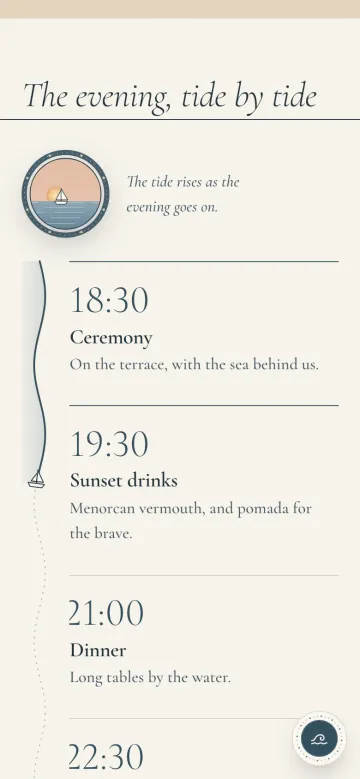
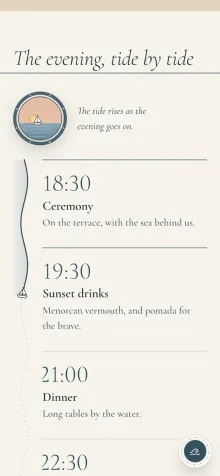
- Marea, with the Menorcan coast and a schedule that rises like the tide; you can try the Marea demo as if you were a guest.
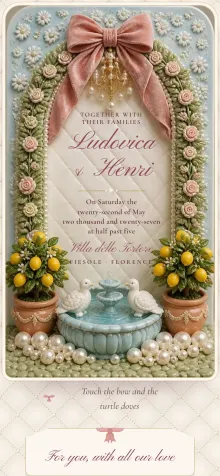
- Bomboniera, with sugar roses, pearls and Tuscan lemon trees for a villa above Florence.
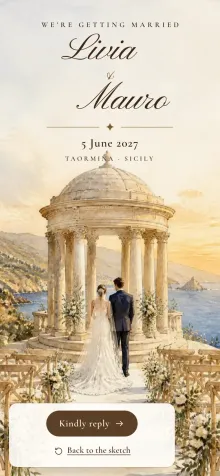
- Acquerello, with a marble temple above the sea at Taormina that colours in under your fingertip.
To compare more styles, every design in our wedding invitation and website collection has a live demo. And below you will find a printable checklist for guests travelling from abroad.
To print
Your wedding website checklist
Tick things off as you go. Your ticks are saved in this browser, and you can print the list or save it as a PDF.
-
As soon as you have a date
-
Six months before
-
Two to three months before
-
Wedding week
Frequently asked questions
Should a bilingual wedding invitation be one card or two versions?
On paper, one card works well with two languages. With three or more, or with a digital invitation, a full version in each language is cleaner: every guest reads their own without hunting for their paragraph.
Which language should come first on a bilingual invitation?
Usually the language of whoever is hosting, or of the country where you are marrying. If you are a mixed couple, alternate between the invitation and the website, or send each family the version in its own language first.
What should we translate for international wedding guests?
Everything practical: date, timings, addresses, transport, accommodation, RSVP, menus and allergies, dress code and gifts. Venue names and local dishes can stay in Spanish or Italian with a short explanation.
How far ahead should we tell guests about a wedding in Spain or Italy?
Send a save the date nine to twelve months before. Guests flying from outside Europe, or who may need a visa, need even more notice to sort documents, flights and annual leave.
Do British guests need anything special to travel to Spain or Italy?
They should check that their passport was issued less than ten years before arrival and will still be valid three months after they leave the Schengen area, and expect fingerprints and a photo under the EU's Entry/Exit System. GOV.UK's travel advice has the current rules.
Designs that suit
Three designs to start imagining it
Each with its own live demo: open it on your phone, just as your guests will see it.
-
Bomboniera
Sugar roses, pearls and Tuscan lemon trees
A diorama of sugar, clay and pearls: a velvet bow, turtle doves on the fountain and gilded gates that open onto the villa.
-
Acquerello
A sketch you paint into colour yourselves
A marble rotunda above the Sicilian sea, drawn in pencil: the guest sweeps a finger like a brush and the watercolour appears; then sepia ink engravings on ochre paper.
Would you rather have it all together, with the invitation, website and save the date in one style? Compare the packages
Keep reading
All journal articles
Wedding websites
Wedding website: what to include and when to send it
A wedding website gathers everything your guests would otherwise text you about into a single link. Here is what to include, when to send it, how to ask about allergies responsibly, and what to sort out if you are marrying in Spain or Italy with guests flying in from the UK and Ireland.

Invitations
Wedding invitation wording: UK etiquette and examples
Who should be named as hosts, what order the details go in, and how to mention a wedding list, an adults-only celebration or a ceremony in Spain or Italy without sounding awkward. With wording you can copy, adapt and send.