

Wedding websites
Wedding website: what to include and when to send it
A wedding website gathers everything your guests would otherwise text you about into a single link. Here is what to include, when to send it, how to ask about allergies responsibly, and what to sort out if you are marrying in Spain or Italy with guests flying in from the UK and Ireland.

What is a wedding website, and how is it different from the invitation?
A wedding website is a private page with its own link where guests find everything they need: where and when each part of the day happens, how to get there, where to stay, what to wear and how to RSVP. Guests return to it again and again, from the day the save the date lands to the morning of the wedding.
The invitation does a different job. It is the formal announcement, short and carefully worded: your names, the date, the venue. Everything that would clutter it, from coach times to hotel suggestions and dietary questions, belongs on the website. If you are still drafting yours, our guide to wedding invitation wording has examples you can copy.
More and more couples combine the two: a digital invitation that opens with a little animation and leads straight to the website. The practical gain is simple. When something changes, you update it once and every guest sees the right version.
What to include on your wedding website
The essentials
- Date, timings and venues. Ceremony, drinks reception, wedding breakfast and evening party, each with a time and an address.
- Getting there. A map and a link that opens directions on a phone.
- RSVP. With plus-ones, menu choices, allergies and, if you are laying one on, the transfer.
- Accommodation. Two or three options at different budgets, with the distance to the venue.
- A contact. Ideally a sibling or friend rather than the two of you in the final month.
The details that save you a hundred messages
- Dress code, plus a practical hint: block heels for lawns and cobbles, a wrap for a lakeside evening.
- Evening guests. If some guests are invited to the evening only, make their timings clear.
- Children. Whether they are invited, and whether there is a children’s menu.
- Wedding list. Mentioned warmly and once.
- Countdown and “add to calendar”. The button downloads an .ics file that opens in any calendar app.
The personal touches
Your story, a few photos, a playlist, a short FAQ and local tips for guests who are making a long weekend of it.
When to send your wedding website: a timeline from save the date to reminders
The website is not sent once; it grows with your plans. Debrett’s notes how invitation timing has shifted:
“Invitations were traditionally sent out a maximum of six weeks before the event” — Debrett’s, on invitations and save-the-date cards (opens in a new tab)
It adds that this is increasingly not enough, and that invitations may now go out up to six months ahead. For a UK wedding, six to eight weeks remains usual; abroad, give people far longer.
| Step | UK wedding | Wedding in Spain or Italy |
|---|---|---|
| Save the date + basic website | 6–12 months before | 9–12 months before |
| Invitation + full website | 6–8 weeks before | around 3 months before |
| RSVP deadline | about 4 weeks before | 6–8 weeks before |
| Reminder to stragglers | a week after the deadline | a week after the deadline |
| Final update (timings, weather) | wedding week | wedding week |
These are conventions, not rules. The firm date is your caterer’s: venues usually want final numbers a few weeks out, so ask for theirs and set your RSVP deadline a week earlier.
A digital save the date carrying the website link lets you give early notice before every detail is settled. As timings and menus arrive, the same website fills in without another mailing. Further down this page you will find a printable wedding website checklist, organised month by month.
RSVPs, allergies and your guest list
A well-designed RSVP form saves time for you and for your caterer. Ask only what you will use: attending or not, plus-one names, menu choice, allergies or intolerances, and a seat on the transfer.
Replies should end up in a single list that shows who has replied, who hasn’t, how many of each menu you need and which allergies to flag; being able to drop it into a spreadsheet is what your table planner and caterer will thank you for. The websites in our wedding website packages include an RSVP with menus, plus-ones and allergies.
Allergies count as health data
Food allergies are information about someone’s health. The ICO’s guidance on what counts as special category data (opens in a new tab) includes data concerning health, which UK GDPR protects more strictly than ordinary personal data. In practice: say on the form why you are asking (the menu), share answers only with the caterer, and delete them after the wedding.
Keeping your wedding website private
A wedding website holds addresses, timings and photos of you. Three simple rules:
- A private, unindexed link. It should reach only the people you invite and should not turn up on Google. Ask whoever builds it whether pages carry a noindex tag.
- No guest details on display. The guest list, phone numbers and allergies live in your private list, never on the page.
- Think about an empty house. If guests need your home address for gifts, send it privately rather than publishing it.
A wedding website in more than one language
If your partner’s family is Spanish or Italian, or you are marrying abroad with friends from several countries, a multilingual website saves a lot of improvised translation in group chats. Translate the practical sections in full (timings, transport, RSVP, accommodation) and leave the more personal text until last.
The number of languages depends on the package: three with Essential, four with Complete, and as many as you need with Premium. Each guest reads the website in their own language and every reply ends up in the same list.
Getting married in Spain or Italy: travel, transfers and the legal side
When most of your guests are flying, the website becomes their travel guide. Think about what someone who has never been to the area would ask.
Flights, transfers and accommodation
- Airports. For Mallorca’s Serra de Tramuntana, Palma; for Lake Maggiore, Milan Malpensa; for Taormina, Catania. Give the drive time to the venue, and suggest checking which UK and Irish airports fly direct in your month.
- Transfers. If you are running a coach from a central point, say where and when it leaves. Otherwise recommend booking a hire car or taxis early, especially in high season.
- Accommodation. Grouping guests in one or two hotels makes transport and the evening far easier.
- Passports. Point British guests to GOV.UK’s travel advice, such as the entry requirements for Spain (opens in a new tab): a passport issued less than ten years before arrival and valid for at least three months after leaving the Schengen area. With the EU’s new Entry/Exit System, they may also need to register fingerprints and a photo at the border.
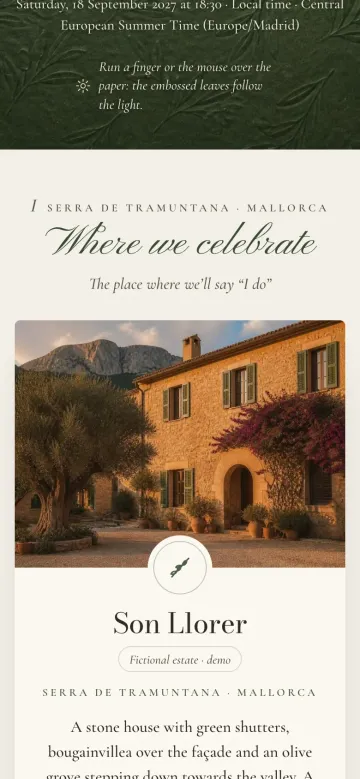
Our designs were born in places like these. Gardenia takes guests to a villa on the shores of Lake Garda, with gardenias and camellias in relief; Tramuntana sets the day among olive trees and stone in the Mallorcan mountains; and Acquerello tells the story of Taormina with a watercolour cover that colours in under your fingertip and an illustrated map of the coast. You can explore the Acquerello demo as if you were a guest.
The legal side
GOV.UK’s guidance on getting married abroad (opens in a new tab) is clear that whether you can marry depends on local law, and that you will need documents proving you are free to marry.
- Spain. According to GOV.UK’s page on getting married in Spain (opens in a new tab), one of you must live in Spain or be a Spanish national. If you live in the UK, you apply for a certificate of no impediment at a UK register office and then exchange it for one issued in Spain. Many couples who don’t qualify marry legally at home and hold a symbolic ceremony in Spain.
- Italy. British nationals need a Nulla Osta, the Italian name for a certificate of no impediment; GOV.UK publishes the Italy certificate of no impediment documents (opens in a new tab). Ask the town hall (comune) where you will marry which documents it needs.
- Ireland. Irish citizens apply to the Department of Foreign Affairs for a Certificate of Freedom to Marry. Its guidance asks for applications at least four months before the wedding.
Settle the paperwork before the date goes on your website.
Ideas for a beautiful wedding website that matches your invitation
- Consistency. The same palette, typeface and illustrations as your invitation and save the date.
- Photos with intent. Three good pictures beat a full gallery: the two of you, the venue, one detail.
- An illustration of the venue. A hand-drawn villa or map gives character and helps people find their way.
- Music, gently. A soft piece when the page opens, never at full volume.
- Your story, kept short. Five lively lines beat a biography.
- Built for phones. That is where almost everyone will open it, so the map and RSVP should be easy to find.
To compare styles before you decide, every design in our wedding website collection has a live demo. And if you are a guest looking for something different from the wedding list, you can give a couple their website with a gift card.
Guides for every step
- When to send save the dates, with timings for local and destination weddings.
- Wedding RSVP etiquette: deadlines, questions and polite reminders.
- Digital vs paper wedding invitations: pros, costs and the mixed option.
- Bilingual wedding invitations for a wedding abroad with international guests.
- Asking for money as a wedding gift: wording and honeymoon funds.
- Wedding seating plan and on-the-day stationery: menus, place cards, table names and print sizes.
- Wedding planning timeline: a month-by-month checklist for the 12 months before.
To print
Your wedding website checklist
Tick things off as you go. Your ticks are saved in this browser, and you can print the list or save it as a PDF.
-
12–9 months before
-
9–6 months before
-
4–2 months before
-
6–3 weeks before
-
The final week
-
After the wedding
Frequently asked questions
What is the difference between a wedding invitation and a wedding website?
The invitation is the formal announcement: who is marrying, when and where. The website is the practical guide that sits behind it, with timings, travel, accommodation, the RSVP form and everything guests will look up more than once.
When should you send your wedding website?
Share the link with your save the dates, six to twelve months ahead, with the basics in place. Fill in the rest before the invitations go out, usually six to eight weeks before a UK wedding and around three months before a wedding abroad.
Is it all right to ask guests about allergies on the RSVP form?
Yes, as long as you only ask what the caterer needs, say why you are asking and share it with no one else. Allergies are health information, which UK data protection law treats as special category data, so delete them once the wedding is over.
Can British couples legally marry in Spain?
According to GOV.UK, one of you must live in Spain or be a Spanish national to marry there. Many couples therefore marry legally at a register office at home and hold a symbolic ceremony in Spain.
Should a destination wedding website be in more than one language?
If your guests come from more than one country, yes. Translate the practical sections in full, such as timings, transport and the RSVP form, so that nobody has to guess at the details.
Designs that suit
Three designs to start imagining it
Each with its own live demo: open it on your phone, just as your guests will see it.
-
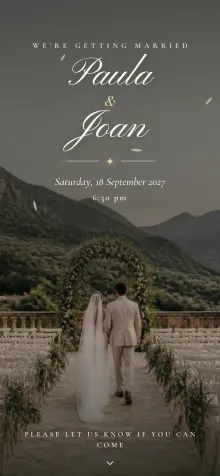
Tramuntana
Olive trees, stone and September light
Full-screen editorial photography, sage-green paper with embossed olive leaves and a glass countdown that lights up as you pass.
-
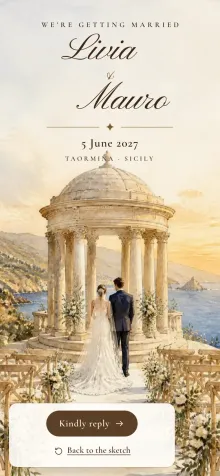
Acquerello
A sketch you paint into colour yourselves
A marble rotunda above the Sicilian sea, drawn in pencil: the guest sweeps a finger like a brush and the watercolour appears; then sepia ink engravings on ochre paper.
Would you rather have it all together, with the invitation, website and save the date in one style? Compare the packages
Keep reading
All journal articles
Invitations
When to send save the dates: timing, wording and etiquette
Send save the dates six to eight months before a UK wedding, and ten to twelve months ahead if guests are flying or the date falls on a bank holiday weekend. Keep them short: your names, the date, the place and a line saying the invitation will follow.
Guests
Wedding RSVP etiquette: deadlines, questions and reminders
Ask for replies with your invitations and set the RSVP date about four weeks before the wedding, always a week ahead of your caterer's deadline for final numbers. Ask only what you will use (attendance, plus-ones, menu choice and allergies), and contact anyone who hasn't replied personally a week after the deadline: below you will find wording and reminder messages ready to copy.