

Stationery
Wedding seating plan and on-the-day stationery: menus, place cards, signs
The table plan, menus, place cards and welcome sign are the first things your guests read when they walk into the reception. Here is which pieces you really need, how to seat everyone without drama, what to write on each one and which sizes to ask your printer for.
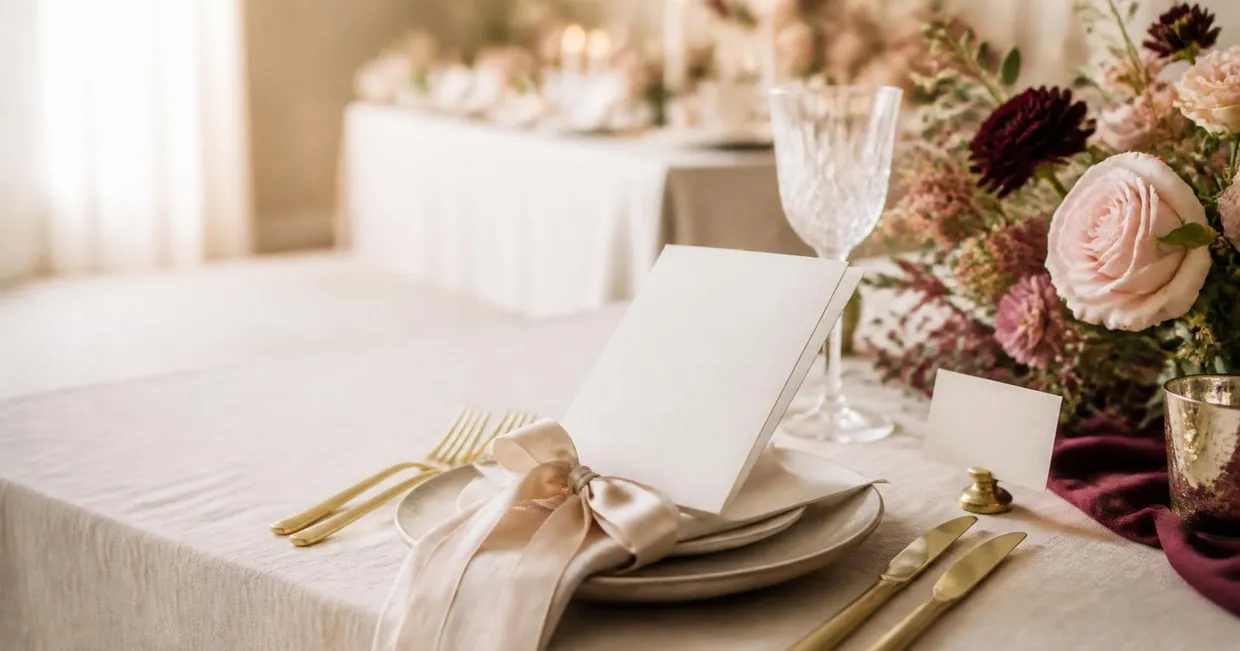
Your invitation is read at home; on-the-day stationery is read standing up, with a glass in one hand and an eye on the nearest chair. That is why it has to be clear before it is pretty, and pretty without anyone having to work to understand it.
What on-the-day stationery is and which pieces you really need
On-the-day stationery is everything printed that your guests find at the ceremony and the reception. You don’t need all of it: it depends on whether seats are allocated, how many guests you have and the style of the day.
| Piece | What it does | Essential? |
|---|---|---|
| Table plan | Helps every guest find their table | Yes, if seats are allocated |
| Table names or numbers | Make each table easy to spot from the door | Yes, with a table plan |
| Menu cards | Tell guests what is being served | Highly recommended |
| Place cards | Mark each guest’s exact seat | Only if you allocate seats, not just tables |
| Welcome sign | Greets and directs guests on arrival | Optional |
| Order of service | Lets guests follow readings, hymns and vows | Optional, useful for longer ceremonies |
| Other signs | Bar, guest book, photo booth, unplugged ceremony | Optional |
| Thank-you cards | Say thank you afterwards | Recommended |
A simple rule: if a piece doesn’t answer a question your guests would ask (“where am I sitting?”, “what’s for dinner?”), it is decoration. Decoration is lovely, but it comes second.
When to prepare your on-the-day stationery
The order matters, because each piece depends on information that arrives at a different time: the design can be chosen early, the menu comes after your tasting and the table plan can only be finished once replies are in.
| When | What to sign off |
|---|---|
| 3–2 months before | Pieces, quantities and design |
| 6–4 weeks before | Final menu, wines and table names |
| 3–2 weeks before | Table plan with confirmed replies |
| 10 days before | Files to the printer |
| Wedding week | Collection, checks and delivery to the venue |
If you are still chasing replies, our guide to wedding RSVP etiquette covers how to set the deadline and what to ask, so the table plan almost writes itself afterwards.
How to make a wedding seating plan, step by step
1. Start from the confirmed list, not the invited list
It sounds obvious, but it is the most common mistake: placing people at tables before they have replied. Work in a spreadsheet with one row per person (not per household) and columns for group, menu choice, allergies and table.
2. Ask the venue about the tables
A round table of 150 to 160 cm across seats 8 to 10 people comfortably; a 180 cm round seats 10 to 12. Long banqueting tables suit big groups but are harder to plan. Ask for a floor plan of the room with the layout: you will need it to name or number the tables.
3. Decide on the top table
The traditional British top table runs, as guests look at it: chief bridesmaid, groom’s father, bride’s mother, groom, bride, bride’s father, groom’s mother and best man. Plenty of couples now adapt it to their families, choose a sweetheart table for two or sit with their friends and let parents host their own tables. All of these are correct; pick the one that causes the least tension in your case.
4. Group in blocks, then fine-tune
First the big groups (each side of the family, university friends, work), then the tables. A few guidelines that work:
- Older guests away from the speakers and close to the exit and the loos.
- Children with their parents, or at a children’s table nearby.
- Couples together; guests who know nobody with people their own age and easy conversation.
- Separated parents at different tables, a sensible distance apart.
5. Check it with someone from each family
The cousin who isn’t speaking to an uncle won’t show up in any spreadsheet. Five minutes with a parent can save you an awkward evening.
6. Choose how to display it
Under about 80 guests, a plan by tables reads well. Above that, an alphabetical list by surname with the table beside each name avoids a queue: everyone looks for their own name, not their table’s.
The Cotswolds
Emily Clarke · James Clarke · Sophie Turner · Tom Hughes
Hannah Price · Oliver Price · Grace Evans · Daniel Evans
Please find your name and your table
Clarke, Emily — The Cotswolds
Clarke, James — The Cotswolds
Evans, Daniel — The Cotswolds
Fletcher, Anna — Edinburgh
Table names: ideas that say something about you
Numbering tables is the most practical choice; naming them is the most personal. If you go for names, make sure they can be read from across the room and follow a single theme:
- Places from your story: the city where you met, a grandparent’s village, your honeymoon destination.
- Places near the venue: villages, beaches or hills nearby, which also give guests from further afield something to talk about.
- Local flowers or trees: wisteria, lavender, oak, olive.
- Songs, films or books you love, as long as people will recognise them.
Avoid names that read like a ranking (“Gold”, “Silver”) or like a joke about the people sitting there. And if you use names, add a small number too: waiting staff work by numbers.
Menu cards: what to write and how to lay them out
The menu tells guests what will be served, in the order it arrives. Ask your caterer for the final wording after your tasting and keep their dish names: they are the ones the kitchen knows.
Charlotte & Henry · 3 July 2027
Heritage tomatoes, burrata and basil oil
Roast sea bass with fennel and lemon
Herb-crusted lamb with crushed new potatoes
Elderflower and strawberry tart
White wine · Red wine · English sparkling wine
Special menus are available: please ask our team.
One menu per person on each plate looks generous, but two or three per table are enough and save paper. The last line matters: food businesses have to give allergen information about the 14 main allergens, as the government’s allergen guidance for food businesses (opens in a new tab) explains. Your caterer provides that information; the menu simply reminds guests who to ask.
Place cards and allergies: discretion first
If you allocate seats rather than just tables, each place card carries the guest’s name and sometimes their menu choice. It is tempting to add their allergy too, but it isn’t a good idea: an allergy is health information, which the ICO lists as special category data (opens in a new tab) that deserves extra care.
The practical answer is to agree a discreet code with your caterer: a small symbol, a coloured corner or a letter only the waiting staff know. The full list, with names and allergies, goes straight to the venue manager.
Welcome sign and order of service
The welcome sign is the first piece your guests see: your names, the date and a short line. If the ceremony and reception are in the same place, it can also point the way. On an easel, A1 or 50 × 70 cm is a comfortable size.
The order of service helps guests follow the readings, hymns or music and the key moments, and it is especially useful when some guests don’t speak English: a bilingual version lets them follow every part. If that is your case, our guide to bilingual wedding invitations covers what is worth translating.
Sizes, paper and printing: how to order without surprises
| Piece | Usual size | Paper or board |
|---|---|---|
| Table plan | A1 or 70 × 100 cm | Foam board or rigid PVC |
| Welcome sign | A1 or 50 × 70 cm | Foam board or rigid PVC |
| Menu card | DL (99 × 210 mm) or A5 | 300–350 gsm card |
| Place card | 90 × 50 mm (folded) | 300–350 gsm card |
| Table name | A6 or 10 × 15 cm | 350 gsm card, with a stand |
| Order of service | A5 folded | 150–200 gsm paper |
Four things your printer will ask for: high-resolution PDFs, 3 mm of bleed on every side, text outlined (or fonts embedded) and a proof before the full run. Always ask for the proof: colours on paper are never quite the colours on screen.
Matching your invitations and website
On-the-day stationery is the last chapter of a story that began with the save the date. Same palette, same typeface, same monogram: guests recognise your wedding as soon as they walk in. If your invitation has an illustration of the venue, repeat it on the welcome sign; if it has a wax seal, bring it onto the menus.
At AMPERSAND we design on-the-day stationery in the same design as your invitation and your wedding website: table plan, menus, place cards, welcome sign and more, as print-ready PDFs, and you choose the printer. Premium includes 8 pieces of your choice; with the other packages you can add the pieces you want individually. Complete and Premium also include a planner with your seating plan.
For inspiration, look at Amélie, drawn in burgundy ink, with a programme laid out like a sketchbook of the table; Ivoire, in ivory silk with a gold seal that looks beautiful on card; or Petit Point, with hand-embroidered details you can repeat on every piece. You can open the Amélie demo and turn the pages of its notebook. The rest are in the collection.
Guides for every step
- Wedding website: what to include and when to send it, the full guide.
- Wedding RSVP etiquette: deadlines, allergies and reminders.
- Wedding invitation wording, with examples to copy.
- Bilingual wedding invitations: languages, travel and timings.
- And if you are looking for a present for a couple who are getting married, you can give them their wedding website and invitations as a gift card.
To print
Your wedding website checklist
Tick things off as you go. Your ticks are saved in this browser, and you can print the list or save it as a PDF.
-
3–2 months before
-
6–4 weeks before
-
3–2 weeks before
-
Wedding week
-
On the day
-
After the wedding
Frequently asked questions
When should you do the wedding seating plan?
Start sketching it as soon as the first replies arrive, but finalise it two to three weeks before the wedding, once your numbers are confirmed. Leave at least ten days between signing it off and handing it to the printer.
Should a table plan be listed by table or alphabetically?
Under about 80 guests, listing by table reads well. Above that, an alphabetical list by surname with the table name beside each guest stops a crowd forming at the easel: everyone looks for their own name, not a whole table.
What goes on a wedding menu card?
The courses in the order they are served, the wines and the fizz, the date and your names or initials. If your caterer agrees, add a line saying that special menus are available and who to ask.
Should you put allergies on place cards?
Better not in writing. Allergies are health information, so agree a small symbol or colour with your caterer instead, and give them the detailed list.
What is the traditional top table order?
Looking at the table from the guests' side, the traditional order runs: chief bridesmaid, groom's father, bride's mother, groom, bride, bride's father, groom's mother and best man. Many couples now adapt it or choose a sweetheart table for two.
Designs that suit
Three designs to start imagining it
Each with its own live demo: open it on your phone, just as your guests will see it.
-
Amélie
Pen-drawn dinner party
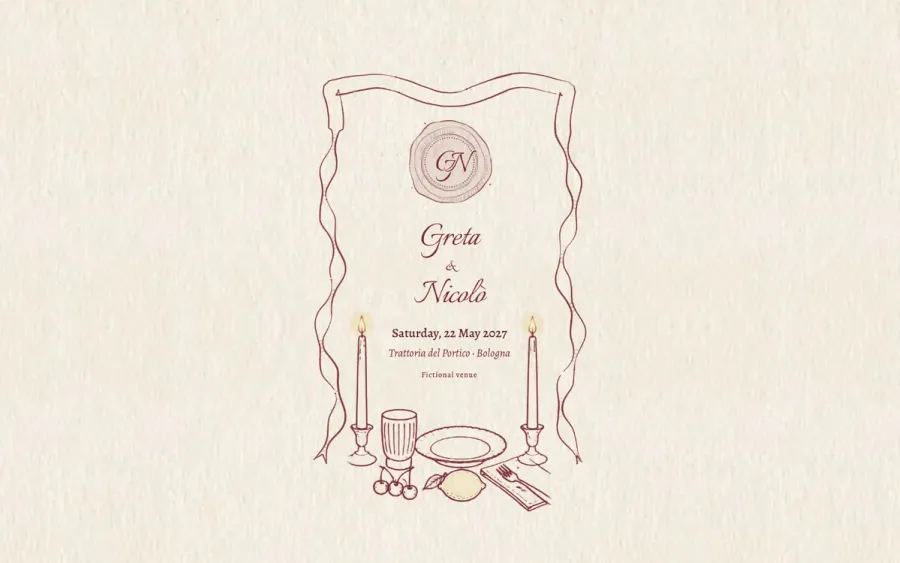
A burgundy pen-and-ink drawing: a bow that comes undone and a dinner table that draws itself.
-
Ivoire
Ivory silk, a golden seal and wisteria
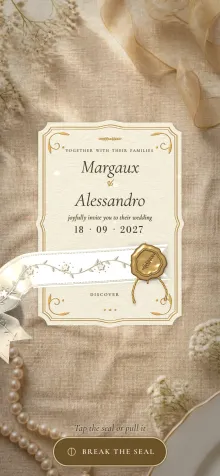
A luxury invitation on champagne linen, in real 3D: the guest breaks the golden wax seal, the cord slips loose and the embroidered silk ribbon unwinds with real physics until the card rises and becomes the website.
-
Petit Point
An invitation embroidered by hand, stitch by stitch
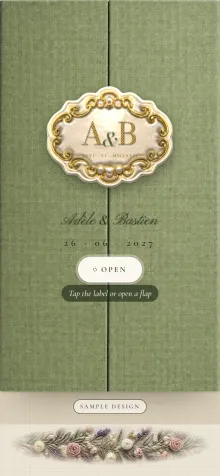
A linen folio with a gold-embroidered label opens like a book: inside, a Provençal bastide, lavender and raised embroidered roses.
Would you rather have it all together, with the invitation, website and save the date in one style? Compare the packages
Keep reading
All journal articles
Wedding websites
Wedding website: what to include and when to send it
A wedding website gathers everything your guests would otherwise text you about into a single link. Here is what to include, when to send it, how to ask about allergies responsibly, and what to sort out if you are marrying in Spain or Italy with guests flying in from the UK and Ireland.
Guests
Wedding RSVP etiquette: deadlines, questions and reminders
Ask for replies with your invitations and set the RSVP date about four weeks before the wedding, always a week ahead of your caterer's deadline for final numbers. Ask only what you will use (attendance, plus-ones, menu choice and allergies), and contact anyone who hasn't replied personally a week after the deadline: below you will find wording and reminder messages ready to copy.