

Invitations
Wedding invitation wording: UK etiquette and examples
Who should be named as hosts, what order the details go in, and how to mention a wedding list, an adults-only celebration or a ceremony in Spain or Italy without sounding awkward. With wording you can copy, adapt and send.
The invitation is the one piece of wedding paper guests keep on the fridge or, these days, the link they reopen on the morning itself to check the time. Good wording does two things: it sets the tone, and it answers every practical question before anyone has to ask.
What goes on a wedding invitation, and in what order
The traditional British order still works, on paper or on screen:
- The hosts: whoever is issuing the invitation.
- The request line: “request the pleasure of your company…”.
- The couple’s names.
- The day, date and time of the ceremony.
- The ceremony venue, with town or village.
- The reception, if it is somewhere else (“and afterwards at…”).
- RSVP details: the reply-by date and how to respond.
- Practical details, ideally on a separate card or your website: dress code, transport, accommodation, gifts.
On a formal printed invitation, the guest’s name is traditionally handwritten in the top left-hand corner and the RSVP address sits in the bottom left. On a digital invitation, the same job is done by sending each guest their own link.
Who is hosting? Wording for parents, the couple or both
The bride’s parents
The classic British form names the bride’s parents as hosts: “Mr and Mrs Giles Hart request the pleasure of your company at the marriage of their daughter Rosalie to Mr Teo Lindqvist”. If one parent is hosting alone, the line adapts naturally: “Mrs Anna Hart requests the pleasure of your company at the marriage of her daughter…”.
Both sets of parents
Name both couples, then “at the marriage of their children”. This works well when both families are contributing and want to be seen to be.
The couple
When you host your own wedding, the wording simply moves to the couple: “Rosalie Hart and Teo Lindqvist request the pleasure of your company at their marriage”, or more relaxed: “Rosalie and Teo are getting married!”.
Together with their families
A graceful middle ground for blended families, divorced parents or anyone who would rather not choose whose names go first: “Together with their families, Rosalie and Teo invite you to celebrate their marriage”.
Honour or pleasure?
In British usage, “request the pleasure of your company” is the standard formal line, whatever the venue. “Request the honour of your presence” is the American convention for a ceremony in a place of worship; some British couples use it for a church wedding, but nobody here will think it wrong to leave it out. If you do use it, spell it the British way: honour.
Wedding invitation wording examples to copy
Swap in your own names, dates and venues, then read the result aloud. If it sounds stiff, cut a line.
Mr and Mrs Giles Hart
request the pleasure of your company
at the marriage of their daughter
Rosalie
to
Mr Teo Lindqvist
at the parish church of St Mary, Little Combe
on Saturday 3 July 2027 at 4pm
and afterwards at Larkspur House.
RSVP by 5 June
Rosalie and Teo
are getting married, and we would love you to be there.
Saturday 3 July 2027, 4pm
Larkspur House, Somerset
Ceremony in the garden, then dinner and dancing until late.
Please reply on our website by 5 June.
Just a few of us, and that’s exactly how we want it.
Rosalie and Teo are marrying at the register office in Bath
on Friday 2 July 2027 at 11am,
followed by a long, unhurried lunch.
Do let us know if you can come by 4 June.
Laura and Marcos
invite you to join them in Gran Canaria for their wedding
on Saturday 12 June 2027 at 6pm local time (the same as UK time)
at Hacienda Los Almendros, Tejeda.
Flights, hotels and transfers are all on our website.
Please RSVP by 12 March so we can confirm numbers with the venue.
We love your little ones, but we have chosen to make our day
a grown-up celebration. We hope you’ll enjoy a night off.
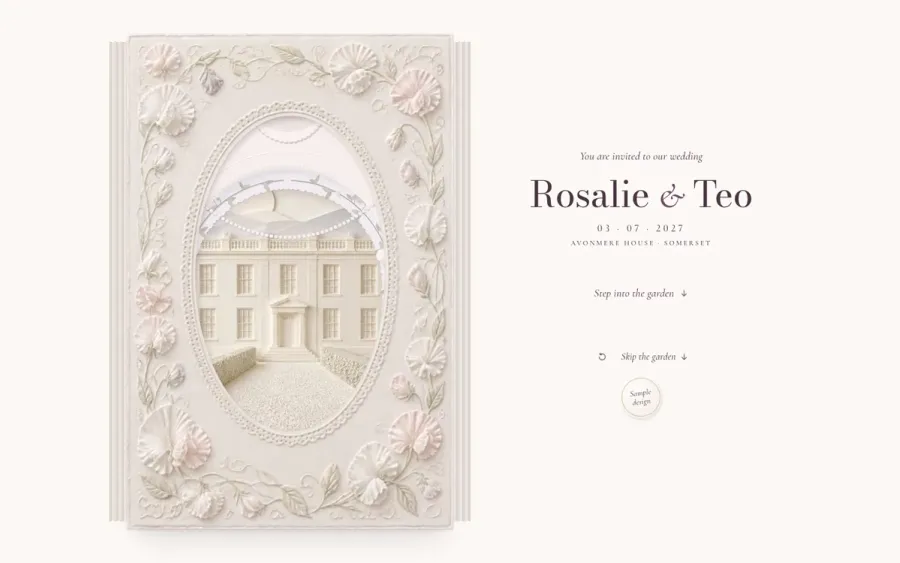
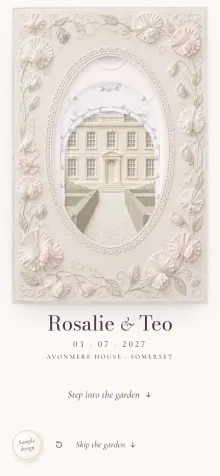
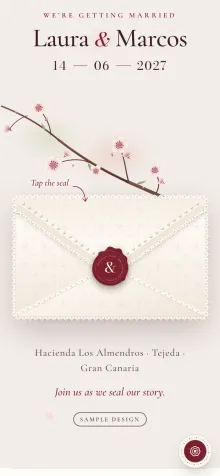
The classic wording sits beautifully in Calado, a tunnel book of cut paper, which you can open in its live demo. For a celebration in Spain, Lacre, with its cream envelope and burgundy wax seal, was designed around exactly that kind of day.
Destination weddings in Spain or Italy: what to add
A wedding abroad needs a few extra lines, and some honesty about what kind of ceremony it is.
- Local time. Mainland Spain and Italy are one hour ahead of the UK and Ireland; the Canary Islands keep the same time. Write “local time” next to the hour.
- Earlier dates. Guests need to book flights and leave, so the save the date goes out early and the RSVP deadline comes sooner than for a wedding at home.
- The legal side. GOV.UK explains that whether you can marry abroad depends on the law of that country (opens in a new tab). If you are doing the legal part at a register office at home and holding a celebration abroad, word it accordingly: “to celebrate the marriage of” rather than “at the marriage of”.
Wedding list and honeymoon fund wording
Gifts never belong on the invitation itself. Put the details on a separate card or a “Gifts” page on your website, keep it to one or two lines, and never mention amounts.
Your presence is present enough.
But if you would like to mark the occasion,
we have a small honeymoon fund for our trip to Italy;
the details are on our website.
A department-store wedding list works the same way: one line and a link. And if you are the guest looking for something less predictable, you can give a couple their wedding website and invitations as a gift.
RSVP wording and deadlines
Your caterer sets the deadline, not you. Ask the venue when they need final numbers and put your RSVP date a week or two before that, leaving time to chase the stragglers. For a UK wedding this usually lands about four weeks before the day.
“RSVP by 5 June” is perfectly correct. Better still, give one way to reply, a website, an email or a single phone number, so you are not reconciling three lists the week before the wedding.
Asking about dietary requirements and allergies
Add one open question to your RSVP: “Any allergies or dietary requirements we should know about?”.
The Food Standards Agency lists 14 allergens that food businesses must declare (opens in a new tab): celery, cereals containing gluten, crustaceans, eggs, fish, lupin, milk, molluscs, mustard, peanuts, sesame, soybeans, sulphur dioxide and sulphites, and tree nuts. Your caterer knows what is in each dish; your job is to tell them who needs what.
A gentle point of discretion: an allergy is information about someone’s health, which the ICO treats as special category data (opens in a new tab). No need to be solemn about it, but share the list only with your caterer, keep it out of the group chat and off printed table plans.
Writing the date and time the British way
British usage puts the day before the month: Saturday 3 July 2027. The GOV.UK style guide for dates and times (opens in a new tab), a good reference for clear modern English, recommends:
- no “th” or “rd” after the number: 3 July, not 3rd July;
- no comma between month and year;
- times as 4pm or 5:30pm, not 16:00hrs;
- “midday” rather than “12 noon”.
Very formal invitations traditionally spell everything out instead: “on Saturday the third of July at four o’clock”. Either is correct; mixing the two on one invitation is not.
Common wording mistakes
| Mistake | Fix |
|---|---|
| Venue name only | Add town and a map |
| “Approximately 4pm” | One exact time: the ceremony |
| RSVP date the caterer can’t work with | Ask before you send |
| No time zone abroad | “Local time” |
| Gift details on the invitation | Separate card or website |
| Vague about plus-ones or children | Name the guests invited |
And one more: not asking a friend to proofread before you send.
What changes with a digital invitation
The wording stays the same. What changes is everything that can sit around it without cluttering it:
- A link to your wedding website with the timings, map, travel and accommodation.
- Online RSVP with menu choices, plus-ones and allergies, so the caterer gets a clear list.
- “Add to calendar”, so nobody writes down the wrong date.
- Several languages, which helps when half the guests are coming from Spain or Italy.
- Updates until the day, without reprinting anything.
Our guide to what a wedding website should include covers the essential pages. You can start with a digital save the date and send the full invitation once every detail is fixed: it comes with every one of our invitation and website packages.
Frequently asked questions
When should wedding invitations be sent in the UK?
Customarily six to eight weeks before the wedding, with a save the date several months earlier. For a wedding abroad, send invitations around three months ahead so guests have time to book travel.
Is it the honour of your presence or the pleasure of your company?
In British usage, request the pleasure of your company is the standard formal line for any venue. The honour of your presence is the American convention for a church ceremony; some British couples borrow it, but it is not required.
How do you word an adults-only wedding invitation?
Address the invitation to the adults by name and add one warm, direct line, such as: We love your little ones, but we have chosen to make our celebration adults only. Avoid apologising at length.
Is it rude to mention a honeymoon fund?
Not if it is kept off the main invitation and phrased lightly. Put it on a separate card or your wedding website, lead with the fact that you simply want guests there, and never suggest an amount.
Who should be named as hosts when both families contribute?
You can name both sets of parents, or use the couple's names with a line such as together with their families. The second option is simpler when there are divorced or remarried parents.
Designs that suit
Three designs to start imagining it
Each with its own live demo: open it on your phone, just as your guests will see it.
-
Calado
A hand-cut paper tunnel book and sweet peas
An invitation that is a hand-cut paper tunnel book: pull a tab, the book unfolds into layers with real depth and, as you scroll, you pass through the peephole into an English garden of sweet peas. Then every section is a paper mechanism: a folding concertina, wheels that count the days, a map that unfolds and a swatch fan.
-
Ivoire
Ivory silk, a golden seal and wisteria
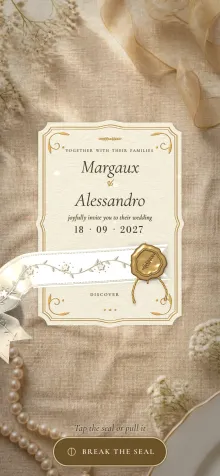
A luxury invitation on champagne linen, in real 3D: the guest breaks the golden wax seal, the cord slips loose and the embroidered silk ribbon unwinds with real physics until the card rises and becomes the website.
Would you rather have it all together, with the invitation, website and save the date in one style? Compare the packages
Keep reading
All journal articles
Invitations
Asking for money as a wedding gift: wording and honeymoon funds
Asking for money as a wedding gift is no longer a faux pas in the UK, as long as it stays off the invitation itself, comes second to the invitation to celebrate and never mentions an amount. Here is where to put the details, wording you can copy for every tone, what guests typically give and how to share bank details without inviting trouble.
Guests
Wedding RSVP etiquette: deadlines, questions and reminders
Ask for replies with your invitations and set the RSVP date about four weeks before the wedding, always a week ahead of your caterer's deadline for final numbers. Ask only what you will use (attendance, plus-ones, menu choice and allergies), and contact anyone who hasn't replied personally a week after the deadline: below you will find wording and reminder messages ready to copy.