

Invitations
When to send save the dates: timing, wording and etiquette
Send save the dates six to eight months before a UK wedding, and ten to twelve months ahead if guests are flying or the date falls on a bank holiday weekend. Keep them short: your names, the date, the place and a line saying the invitation will follow.
What is a save the date, and how is it different from the invitation?
A save the date is an early heads-up: you are getting married, this is the day, this is roughly where, so please keep it free. Nothing more. It is less formal than an invitation and arrives long before you have settled timings, menus or the order of the day.
The invitation does the real work later on, with the venue address, timings, dress code and an RSVP deadline. If you are already drafting yours, our guide to wedding invitation wording covers who hosts, how to phrase it and wording you can copy.
One rule to keep in mind from the start: anyone who receives a save the date will assume they are invited. They are not for “maybes” or a provisional list.
When to send save the dates: timings for every kind of wedding
There is no fixed rule, but there is a well-established convention. The more a guest has to organise (flights, annual leave, childcare), the more notice they need.
| Type of wedding | Save the dates | Invitations |
|---|---|---|
| Local, most guests nearby | 6–8 months before | 6–8 weeks before |
| Elsewhere in the UK, lots of travel | 8–10 months before | 2–3 months before |
| Destination wedding abroad | 10–12 months before | about 3 months before |
| Bank holiday, school holidays or peak summer | 2 months earlier than usual | as above |
| Short engagement (under 5 months) | not needed | as soon as the venue is booked |
Any later than four or five months out, a save the date arrives almost alongside the invitation and loses its point. Much more than a year ahead and it tends to be forgotten, unless guests need time to save up for a long-haul trip.
Bank holidays and school holidays in 2027
If your wedding falls near a bank holiday, guests will be weighing it against long weekends booked months ago. GOV.UK publishes the UK bank holiday dates (opens in a new tab); for 2027 in England and Wales they include:
- Easter: Good Friday 26 March and Easter Monday 29 March.
- May: the early May bank holiday on Monday 3 May and the spring bank holiday on Monday 31 May.
- August: the summer bank holiday on Monday 30 August. In Scotland it falls on Monday 2 August.
School summer holidays matter just as much. A wedding in late July or August competes with family holidays that are often booked in January, so families with children need your save the date before then.
What to put on a save the date (and what to leave for the invitation)
The essentials fit on four lines:
- Your names. In whichever order feels natural to you.
- The full date, with the day of the week: “Saturday 3 July 2027”. Numerals are fine here; the formal written-out date can wait for the invitation.
- The place, even if it is only the town or county while the venue contract is being signed.
- “Invitation to follow”, so nobody texts you asking what time the ceremony starts.
If you already have a wedding website, even with just the date and a few places to stay, add the link. It is what guests booking flights or hotels will thank you for. Our guide to what a wedding website should include covers it section by section.
What does not belong on a save the date: timings, menus, dress code, gift list details and the RSVP. All of those get decided later, and putting them on early means correcting them later.
Save the dates for evening guests
You don’t have to send them, but if you do, say clearly that the invitation is for the evening reception. “Evening reception to follow” or “Join us for the evening celebrations” avoids the awkward moment when someone books a hotel for the ceremony they were never invited to.
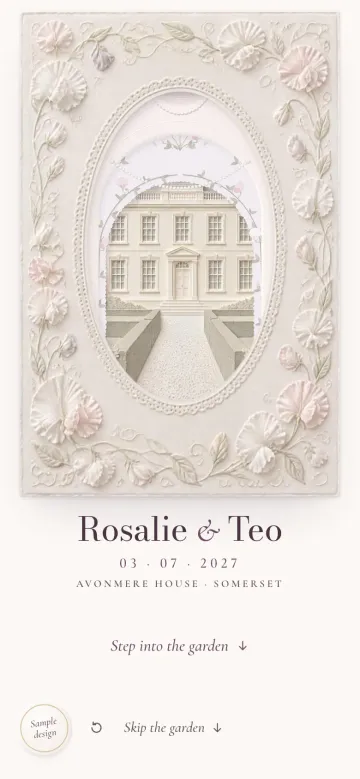
Save the date wording: examples to copy
Swap in your own names, date and place. All four work on a digital save the date, a printed card or a message.
Save the date
Rosalie & Teo
Saturday 3 July 2027
Avonmere House, Somerset
Invitation to follow
We’re getting married!
Hannah and James, Saturday 29 May 2027, in the Cotswolds.
It’s the spring bank holiday weekend, so stay for the Sunday roast.
Formal invitation to follow.
Elisa and Tommaso are getting married on Lake Maggiore
on Saturday 3 July 2027.
We’re telling you a year ahead so you can find good flights.
Airports, hotels and boats are already on our website; invitations will follow in the spring.
Save the evening
Margaux and Alessandro
Saturday 18 September 2027, from 8pm
Sintra, Portugal
Evening reception invitation to follow
How to send save the dates: digital, by post or by message
Digital save the dates
For most weddings this is the practical choice: it arrives instantly, opens on a phone and can lead straight to your website. If something changes before the invitations go out (a hotel suggestion, the venue’s name), you update the website and nobody needs a second mailing.
One technical point worth knowing: links for sharing a Google Calendar event expire after 90 days (opens in a new tab), so they don’t work for a notice sent eight months ahead. It is better if the save the date itself has a button that saves the date to each guest’s calendar.
By email
If you are emailing a group, put the addresses in Bcc rather than To or Cc. The ICO’s guidance on email and security (opens in a new tab) is written for organisations, but the lesson carries over: using Cc by mistake exposes everyone’s address, and for a small list a separate email to each person is safer still.
By WhatsApp or text
A personal message with the link beats a group chat of 150 guests, where everyone’s number is on show and the replies never stop.
By post
Still the right choice for grandparents and anyone who doesn’t live on their phone. Many couples do both: digital for most guests and a handful of printed cards by post.
Our save the date, included in every package
All our wedding invitation and website packages include a digital save the date: an envelope that opens with a tap, your date with a countdown, a button to add it to the calendar and music only if the guest chooses it. You share it as a link, by message or by email. With Essential it uses the catalogue design you choose; with Complete it is personalised; with Premium it is exclusive, like the rest of your stationery.
Save the dates for a destination wedding
When most of your guests are flying, the save the date doubles as the first travel notice. Three things make the difference:
- Real notice. Ten to twelve months. Affordable flights and hotels near the venue go first, especially on islands and around the Italian lakes in summer.
- Each guest’s language. If your partner’s family is Spanish or Italian, send the save the date in their language too. Our wedding websites are multilingual: three languages with Essential, four with Complete and as many as you need with Premium.
- Passports. Remind British guests to check theirs now. For Italy, GOV.UK’s entry requirements (opens in a new tab) say a passport must have been issued less than ten years before arrival and be valid for at least three months after leaving the Schengen area. Under the EU’s Entry/Exit System, guests may also need to register fingerprints and a photo at the border, so allow time on arrival.
Common save the date mistakes
- Sending them before the date is signed. If the venue is only “pencilled in”, wait. Changing an announced date means apologising to everyone.
- Sending one to someone you might not invite. A save the date is a commitment. If the list is uncertain, start with the definite guests.
- Leaving out the day of the week. “3 July” alone invites questions; “Saturday 3 July” doesn’t.
- Promising details you don’t have yet. “Invitation to follow” is better than a time that later changes.
- Never sending the invitation. A save the date doesn’t replace it: without one, nobody knows when to arrive or when to RSVP by.
Save the date ideas that set the tone for the day
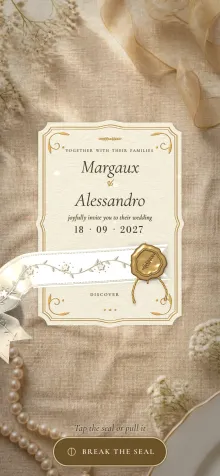
Your save the date is the first piece of stationery guests see, so it sets the tone. For a country-house wedding, Calado, a tunnel book of cut paper and sweet peas, unfolds layer by layer into an English garden; you can try the Calado live demo as a guest would. For a wedding abroad there is Ivoire, on champagne linen with a gold wax seal and a silk ribbon that unwinds, and for the Italian lakes, Gardenia, with an embossed cotton envelope that opens like a flower.
What matters most is consistency: the same palette, typeface and motif across your save the date, invitation and website. Every design in our collection of wedding invitations and websites has a live demo. And if you have received a save the date yourself and want a gift that isn’t on the list, you can give the couple their invitation and website as a gift.
To print
Your wedding website checklist
Tick things off as you go. Your ticks are saved in this browser, and you can print the list or save it as a PDF.
-
Before you design them
-
Before you send them
-
After you send them
Frequently asked questions
How far in advance should you send save the dates?
Six to eight months before a UK wedding where most guests live nearby. For a summer or bank holiday weekend, a wedding abroad, or a guest list with lots of travellers, send them ten to twelve months ahead.
Do you have to send save the dates?
No, they are optional. They are worth sending when you want guests to keep a date free well in advance. If the wedding is less than four or five months away, go straight to invitations.
Who should get a save the date?
Only people you are certain to invite, because receiving one means you are invited. If part of your list is still undecided, send save the dates to the definite guests and wait for the invitations for the rest.
Should evening guests get a save the date?
They can, as long as the wording makes clear they are invited to the evening reception only. If you are not sure yet who will be an evening guest, wait and send them an invitation instead.
Do you still need invitations after save the dates?
Yes. A save the date only announces the date. The invitation follows, usually six to eight weeks before a UK wedding and about three months before a wedding abroad, with timings, the venue and the RSVP deadline.
Designs that suit
Three designs to start imagining it
Each with its own live demo: open it on your phone, just as your guests will see it.
-
Calado
A hand-cut paper tunnel book and sweet peas
An invitation that is a hand-cut paper tunnel book: pull a tab, the book unfolds into layers with real depth and, as you scroll, you pass through the peephole into an English garden of sweet peas. Then every section is a paper mechanism: a folding concertina, wheels that count the days, a map that unfolds and a swatch fan.
-
Ivoire
Ivory silk, a golden seal and wisteria
A luxury invitation on champagne linen, in real 3D: the guest breaks the golden wax seal, the cord slips loose and the embroidered silk ribbon unwinds with real physics until the card rises and becomes the website.
Would you rather have it all together, with the invitation, website and save the date in one style? Compare the packages
Keep reading
All journal articles
Wedding websites
Wedding website: what to include and when to send it
A wedding website gathers everything your guests would otherwise text you about into a single link. Here is what to include, when to send it, how to ask about allergies responsibly, and what to sort out if you are marrying in Spain or Italy with guests flying in from the UK and Ireland.
Invitations
Wedding invitation wording: UK etiquette and examples
Who should be named as hosts, what order the details go in, and how to mention a wedding list, an adults-only celebration or a ceremony in Spain or Italy without sounding awkward. With wording you can copy, adapt and send.