

Invitations
Digital vs paper wedding invitations: which to choose
If nearly all your guests live on their phones, digital invitations are easier, cost nothing to post and can be updated in seconds; paper still wins for grandparents and very formal weddings. For most couples the right answer is a mix: digital for everyone, plus a small run of printed invitations, delivered by hand, for the guests who will truly value them.
Choosing between digital and paper wedding invitations is not only about style or budget. It comes down to who your guests are, how much might change between now and the day, and what kind of keepsake you want to leave behind. Here are the real postage costs, the etiquette question, and a way to combine the two without doing everything twice.
Digital vs paper wedding invitations: the short answer
- Digital, if most guests use their phones every day, if people are travelling from abroad, or if timings, transport and accommodation are not settled yet.
- Paper, if the wedding is very formal, if many guests are older, or if the invitation is, for you, an object to keep.
- A mix, in almost every other case: digital as the main invitation, and a few printed copies for the people who will genuinely appreciate them.
Digital, paper or both: a side-by-side comparison
| Digital | Paper | Mixed | |
|---|---|---|---|
| Postage | None per guest | A stamp per household | Only for the printed few |
| Last-minute changes | Update the website and everyone sees it | Reprint, or tell guests one by one | The website stays the source |
| RSVPs | In the invitation, with menu choices and allergies | Reply cards, calls and messages | Website for most, phone for older guests |
| Older guests | May leave out those who are not online | Easiest for them | Everyone gets what suits them |
| Keepsake | Not unless you print it | Kept, framed, stuck on the fridge | For those who care |
| Timing | Sent the same day | Printer, envelopes and post | One short print run |
| Environmental footprint | Small, but not zero | Paper, ink and delivery | Far less paper than a full suite |
How much does it cost to post paper wedding invitations?
The part couples underestimate is rarely the printing. It is everything that follows: envelopes, stamps, addresses and evenings spent licking flaps.
Royal Mail’s current postage prices (opens in a new tab) put a first class letter at £1.80 and a second class letter at 91p. Watch the format, though. Royal Mail’s size and weight guide (opens in a new tab) defines a letter as no larger than 24cm by 16.5cm, no thicker than 5mm and no heavier than 100g. A pocketfold with a ribbon, a chunky wax seal or a layered suite can easily tip over 5mm, at which point it becomes a Large Letter and costs more.
To put numbers on it: 70 households cost £63.70 in second class stamps or £126 in first class. If you include a reply card with a stamped addressed envelope, that roughly doubles. None of this covers printing, envelopes, calligraphy or the time it all takes.
A digital invitation, by contrast, costs nothing per send. The same link goes to 30 or 300 guests, and if someone loses it you simply send it again. The cost lies in the design, not the delivery.
Are digital wedding invitations tacky?
No. If anything feels off, it is the way an invitation is sent, not the format. A generic image forwarded to a group chat of two hundred people says “we were in a hurry”. A personal message, using each guest’s name, a few lines of your own and a link to a properly designed invitation says the opposite.
British weddings have one tradition where digital fits naturally: the evening invitation. Many couples invite a smaller group for the ceremony and wedding breakfast and a wider circle for the evening. A digital invitation for evening guests, with its own timings and directions, is now entirely usual.
To make sure a digital invitation feels like an invitation rather than a notification:
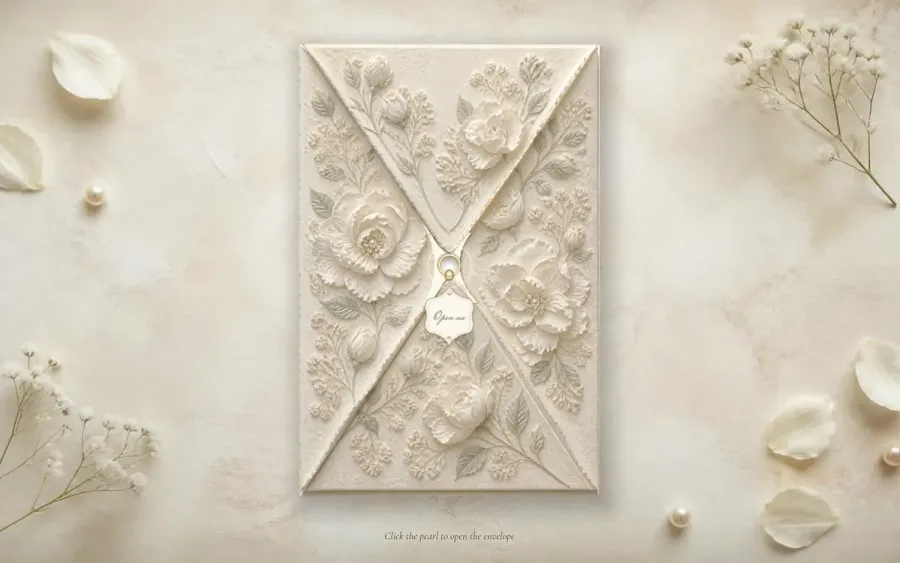
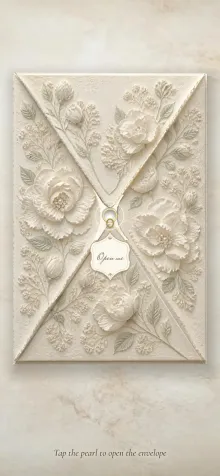
- Give it a moment of opening. An envelope that opens on screen, such as Gardenia, an embossed cotton-paper envelope, or Lacre, which opens when the wax seal breaks, brings back the small ritual of opening something.
- Name your guests. “Dear Harriet and Tom” makes it clear exactly who is invited, which matters for adults-only weddings and plus-ones.
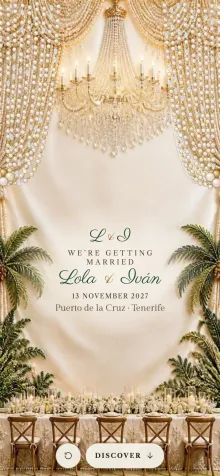
- Match the formality of the day. A black-tie evening deserves an invitation that looks the part: La Gala, with its curtains of pearls, was designed for exactly that kind of night.
The wording is the same on paper and on screen. If you are unsure about hosts, order or phrasing, our guide to wedding invitation wording covers it.
What if the wedding is very formal?
For a church wedding with the bride’s parents as hosts and a formal dress code, many guests will still expect card through the letterbox. This is where a mixed approach shines: printed invitations for family and older friends, digital for everyone else, and the website as the shared home for every practical detail.
Older guests: how not to leave grandparents behind
This is the strongest argument for paper. In its response to the government’s Digital Inclusion Action Plan (opens in a new tab), Age UK reports that 2.3 million people aged 65 and over in the UK do not use the internet, around one in five of that age group, and that around 3.3 million do not use a smartphone.
What works for them:
- Paper, delivered by hand. A printed invitation in a generous type size that does not depend on scanning a QR code.
- A go-between. Ask a son, daughter or grandchild to reply for them on your website and to pass on the practical details: the coach, the time it leaves.
- A phone call before the day. That is what they will remember.
Which is more sustainable, paper or digital?
The honest answer: it depends on how each is done. There is no reliable comparison that applies to every wedding, so be wary of neat headline numbers.
What we do know about paper is that it recycles well when it is just paper. Recycle Now advises that ribbons and glitter on greetings cards should be torn off before recycling (opens in a new tab). Lamination, foil, glued-on wax seals and glitter all make it harder for your invitation to become paper again.
Digital has a footprint too: the International Energy Agency estimates that data centres accounted for around 1.5% of the world’s electricity consumption in 2024 (opens in a new tab). Even so, a shared link needs no printing, envelopes or delivery van, and above all it avoids reprinting when something changes.
If you do print, four simple rules:
- Print only for the guests who need it, not for everyone “just in case”.
- Choose recycled paper or paper with forest certification.
- Skip lamination, glitter and embellishments that cannot be removed.
- Keep anything that might change (timings, transport) on the website, so nothing needs reprinting.
The mixed approach: paper and digital without double the work
For a wedding with several generations around the tables, this is usually the best fit. Set up well, it does not double the effort:
- One source of truth. Your wedding website holds the timings, map, accommodation and RSVPs. Our guide to what a wedding website should include lists the essential pages.
- Digital invitations for most guests, each sent with a personal message.
- A short printed run for grandparents and relatives, with the same wording and a QR code leading to the website for anyone who wants it.
- One list of replies. Any RSVPs that arrive by post or phone, you (or a willing grandchild) add on the website, so the caterer receives a single list.
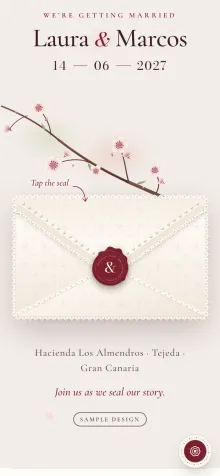
At AMPERSAND we look after the digital side: invitations with an animated opening (an envelope, a wax seal or a curtain), RSVPs with menu choices and allergies, a website in 3, 4 or as many languages as you need depending on the package, details you can update until the wedding, and a save the date included in every one of our invitation and website packages. If you love paper on the day itself, the Premium package includes eight pieces of on-the-day digital stationery (menus, table plan, place cards…) in your design and ready to print; with the other packages you can add pieces individually. The physical printing is yours to arrange, with whichever printer you like.
When to choose only paper, and when only digital
Paper only makes sense if the wedding is small and most guests belong to your grandparents’ generation, if the invitation is part of a very traditional ceremony, or if it is, above all, a keepsake for you.
Digital only suits a wedding where nearly every guest is your age, where many are travelling from abroad, where you are marrying at short notice, or where timings and logistics are still being settled.
In every other case, mix the two. And whatever you choose, proofread twice: a typo on a website takes a minute to fix; on a hundred envelopes, it does not.
Frequently asked questions
Are digital wedding invitations tacky?
Not when they are done with care. What feels careless is a generic image dropped into a group chat. A personal message to each guest, using their name, with a link to a beautifully designed invitation is perfectly correct. For grandparents and older relatives, a printed invitation or a phone call is kinder.
How much does it cost to post wedding invitations in the UK?
A first class stamp currently costs £1.80 and second class 91p, for a standard letter up to 100g and 5mm thick. Anything thicker, such as a pocketfold with a ribbon or a wax seal, becomes a Large Letter and costs more. Add printing, envelopes and any stamped reply envelopes.
What should we do about older guests who are not online?
Send them a printed invitation, ideally by hand, and ask a son, daughter or grandchild to reply for them on your website. Age UK reports that 2.3 million people aged 65 and over in the UK do not use the internet.
Are digital invitations better for the environment?
Sending a link avoids paper, ink and delivery, although digital is not impact-free. If you print, choose recycled or certified paper and avoid glitter, foil and embellishments that cannot be torn off, because they stop the card being recycled.
Can you mix paper and digital wedding invitations?
Yes, and it is often the most sensible choice: digital invitations for most guests and a short printed run for grandparents and anyone who prefers paper, with the same wording and a QR code that leads to the website, where every detail stays up to date.
Designs that suit
Three designs to start imagining it
Each with its own live demo: open it on your phone, just as your guests will see it.
-
Gardenia
An embossed cotton envelope, a pearl and gardenias
A cotton-paper envelope sculpted in bas-relief with gardenias, camellias and sage leaves, in real 3D: light plays across the relief with your cursor, the tag sways from its pearl and, at a touch, the four flaps open like a flower and the card rises to become the website.
-
La Gala
Pearl curtains, a crystal chandelier and a grand night
Curtains of pearl and crystal strands that move under your finger, a chandelier that lights up and an embroidered palm court; the dress code is shown with illustrated guests.
Would you rather have it all together, with the invitation, website and save the date in one style? Compare the packages
Keep reading
All journal articles
Invitations
Wedding invitation wording: UK etiquette and examples
Who should be named as hosts, what order the details go in, and how to mention a wedding list, an adults-only celebration or a ceremony in Spain or Italy without sounding awkward. With wording you can copy, adapt and send.
Invitations
When to send save the dates: timing, wording and etiquette
Send save the dates six to eight months before a UK wedding, and ten to twelve months ahead if guests are flying or the date falls on a bank holiday weekend. Keep them short: your names, the date, the place and a line saying the invitation will follow.