

Wedding planning
Wedding planning timeline: a month-by-month checklist
Planning a wedding isn't hard, it's long. What wears you out isn't the number of jobs but not knowing which one comes next. Here is the month-by-month timeline we use with our couples: what to decide first, when to send each announcement and a printable checklist to tick off.

Planning a wedding is a lot like organising a long trip for a lot of people: not difficult, but it has an order. Follow it and each decision sets up the next; skip it and you end up choosing invitations before you know how many guests the venue can hold.
This timeline assumes 12 months to go. If you have less, don’t panic: compress the stages, but keep the sequence.
The three decisions that put everything in order
Before you view venues or browse outfits, sit down with a cup of tea and settle three things. They don’t need to be exact, just honest.
- A season or rough date. Saturdays from May to September book up more than a year ahead, and bank holiday weekends go fastest. A Friday, a Sunday or a quieter month gives you more choice and better prices. Check the UK bank holidays (opens in a new tab) before you fix a date, and the Met Office climate averages (opens in a new tab) for the area if you are torn between two months.
- An approximate guest count. Write two quick lists: the must-haves and the would-likes. The gap between 90 and 160 guests changes the venue, the catering and the budget.
- A maximum budget. The total you are prepared to spend, including any family contributions. Keep 10 % aside for the unexpected from day one.
The wedding timeline at a glance
| When | What to decide or send |
|---|---|
| 12–10 months before | Date, venue, ceremony, budget and draft guest list |
| 9–7 months before | Key suppliers, design, wedding website and save the dates |
| 6–4 months before | Outfits, guest accommodation, gift list and wording |
| 3–2 months before | Invitations, menu tasting and notice of marriage |
| Final month | RSVPs, seating plan, on-the-day stationery and balances |
| Wedding week | Wedding-day box, helpers and rest |
| Afterwards | Thank-yous, photos and paperwork |
12 to 10 months before: venue, ceremony and guest list
The venue calls the shots. Its availability fixes the date, its capacity limits the list and its supplier policy (in-house catering or free choice) changes the budget. View three or four at most and ask each the same questions: seated capacity, music curfew, wet-weather plan, what the price per head includes and what it doesn’t.
With the venue booked, secure the ceremony: a register office, a church or an approved venue. If you are marrying abroad, in Spain or Italy for example, start on the paperwork now: GOV.UK explains what is needed for marriages abroad (opens in a new tab), and some documents take months to arrive.
Draft the guest list in a spreadsheet with one row per person, not per household. Add columns for group (each family, friends, work), whether they are travelling, whether they bring children and, later, their reply and menu. The same sheet will carry you through RSVPs and the seating plan.
9 to 7 months before: suppliers, design and save the dates
The suppliers who book up earliest are photographers, videographers, bands and caterers when the venue doesn’t provide one. Ask for fixed quotes, read what each extra hour costs and keep every contract in one folder.
This is also the moment to choose the wedding design. It pays to decide now rather than when you order invitations: save the date, website, invitation and on-the-day stationery should share a palette, typeface and monogram, and the first announcement goes out straight away.
- Send save the dates six to eight months ahead, or ten to twelve for a destination wedding. Our guide on when to send save the dates has timings for every kind of wedding and wording to copy.
- Publish your wedding website at the same time, even if it only has the date, place and where to stay. It will save you dozens of messages; our full guide to what a wedding website should include walks through every section.

6 to 4 months before: outfits, travelling guests and gift list
Outfits need several fittings, so put them in the diary. If guests are travelling, now is when they appreciate knowing recommended hotels, how to get there and whether a coach will run from the hotel to the venue. If part of your list is coming from abroad, our guide to bilingual wedding invitations covers what to translate and how to plan travel and timings.
Decide how you would like to receive gifts: a gift list, a honeymoon fund or bank details. If you are leaning towards money, here is how to ask for money as a wedding gift gracefully and safely, with wording ready for your website.
Finalise the invitation wording here: who is hosting, times, places and the reply-by date. Our guide to wedding invitation wording has the order of information and examples to copy.
3 to 2 months before: invitations, menu and notice of marriage
Invitations go out two to three months before the day. Paper versus digital isn’t all or nothing: many couples send the digital invitation to everyone and a printed one to grandparents and close family. Our comparison of digital vs paper wedding invitations covers pros, costs and the mixed option.
The caterer will offer a menu tasting: try the wines too and ask about children’s and special menus.
In England and Wales, this is also the window to give notice of marriage. According to GOV.UK, you must give notice at least 29 days before the ceremony (opens in a new tab), and the wedding has to take place within 12 months of giving notice. Book the register office appointment early: slots in popular areas fill up.
The final month: RSVPs, seating plan and on-the-day stationery
This is the month of small jobs, and nearly all of them depend on one: the RSVPs. Set the deadline three or four weeks before the wedding, ask about menus and allergies on the same form and have a polite reminder ready for anyone who doesn’t reply. It’s all in our guide to wedding RSVP etiquette.
With the list closed, the seating plan almost writes itself. Then come menus, place cards, table numbers and the welcome sign: our guide to the wedding seating plan and on-the-day stationery covers how to arrange the tables and the sizes printers expect.
Prepare a one-page order of the day with times and names, and send it to the photographer, venue, band and your wedding party. It’s the document that brings the most peace of mind.
Wedding week and the day itself
The last week isn’t for deciding, it’s for delegating. Pack a box with all the on-the-day stationery, favours, gifts for your wedding party, the guest book and a small emergency kit (safety pins, plasters, tissues, a phone charger). Label it with the name of the person in charge.
Share out the jobs: who meets the suppliers at the venue, who looks after cards and gifts, who helps the photographer round up the group shots. And on the day itself, put your phone away for a while. Whatever isn’t done by now, someone else will do.
After the wedding
The weeks afterwards have three jobs: thank-you notes to your guests, collecting and choosing the photos and, if you are changing your name, updating your documents. A wedding website that stays online for a few months is the natural place to share your favourite photos and thank everyone at once.
How AMPERSAND helps
All our packages include a 12-month wedding checklist, step by step. Complete and Premium add a full planner: checklist, budget, seating and the on-the-day timeline, shared privately with you. And your website stays online for twelve months after the wedding, for photos and thank-yous.
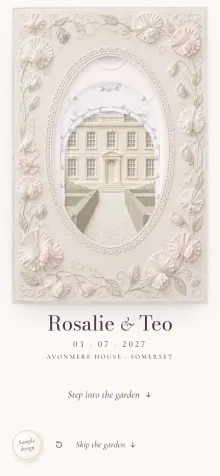
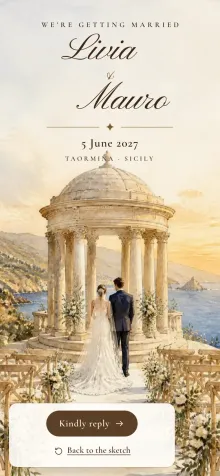
The design carries through everything: save the date, website, invitation and, if you’d like it, the on-the-day stationery. Have a look at Céladon, a boiserie panel that blossoms when guests tap it; Calado, a tunnel book of cut paper; or Acquerello, a pencil sketch your guests colour in with a fingertip. You can open the Céladon demo and explore it the way your guests would, or browse the whole collection.
Guides for every step
- Wedding website: what to include and when to send it, the complete guide.
- When to send save the dates, with timings for local and destination weddings.
- Wedding invitation wording, with examples to copy.
- Wedding RSVP etiquette: deadlines, allergies and polite reminders.
- Wedding seating plan and on-the-day stationery: menus, place cards and print sizes.
- And if you are looking for a present for a couple who have just started planning, you can give them their wedding website and invitations with a gift card.
To print
Your wedding website checklist
Tick things off as you go. Your ticks are saved in this browser, and you can print the list or save it as a PDF.
-
12–10 months before
-
9–7 months before
-
6–4 months before
-
3–2 months before
-
The final month
-
Wedding week
-
After the wedding
Frequently asked questions
How far in advance should you start planning a wedding?
Most couples start 12 to 18 months ahead, especially for a popular venue in peak season. Six to eight months is perfectly doable too, but you will have fewer dates and suppliers to choose from.
What is the first thing to do when planning a wedding?
Settle three things together: a season or rough date, an approximate guest count and a maximum budget. With those three decisions you can start looking for a venue, which shapes everything else.
When should wedding invitations be sent?
Two to three months before the wedding, a little earlier if many guests are travelling. Save the dates go out first, six to eight months ahead, or ten to twelve months for a destination wedding.
When do you have to give notice of marriage?
In England and Wales you must give notice at least 29 days before the ceremony, and the wedding has to take place within 12 months of giving notice. Book the appointment at your local register office as soon as you have a date in that window.
How much should you keep aside for unexpected costs?
A good rule of thumb is around 10 % of the total budget: overtime, an extra guest, transport or an invoice that comes in higher than expected.
Designs that suit
Three designs to start imagining it
Each with its own live demo: open it on your phone, just as your guests will see it.
-
Céladon
A celadon boiserie panel that comes to life
An invitation that is a boiserie panel from an eighteenth-century Viennese salon: guests tap the plaster cartouche, light sweeps across the relief, branches grow, peonies open, a porcelain bird brings a silk ribbon and the names appear carved before the mouldings swing open like doors onto a palace garden. Then every section is a different panel: a programme that blossoms along a branch, a map in relief and a framed gallery.
-
Calado
A hand-cut paper tunnel book and sweet peas
An invitation that is a hand-cut paper tunnel book: pull a tab, the book unfolds into layers with real depth and, as you scroll, you pass through the peephole into an English garden of sweet peas. Then every section is a paper mechanism: a folding concertina, wheels that count the days, a map that unfolds and a swatch fan.
-
Acquerello
A sketch you paint into colour yourselves
A marble rotunda above the Sicilian sea, drawn in pencil: the guest sweeps a finger like a brush and the watercolour appears; then sepia ink engravings on ochre paper.

Would you rather have it all together, with the invitation, website and save the date in one style? Compare the packages
Keep reading
All journal articles
Wedding websites
Wedding website: what to include and when to send it
A wedding website gathers everything your guests would otherwise text you about into a single link. Here is what to include, when to send it, how to ask about allergies responsibly, and what to sort out if you are marrying in Spain or Italy with guests flying in from the UK and Ireland.

Invitations
When to send save the dates: timing, wording and etiquette
Send save the dates six to eight months before a UK wedding, and ten to twelve months ahead if guests are flying or the date falls on a bank holiday weekend. Keep them short: your names, the date, the place and a line saying the invitation will follow.